
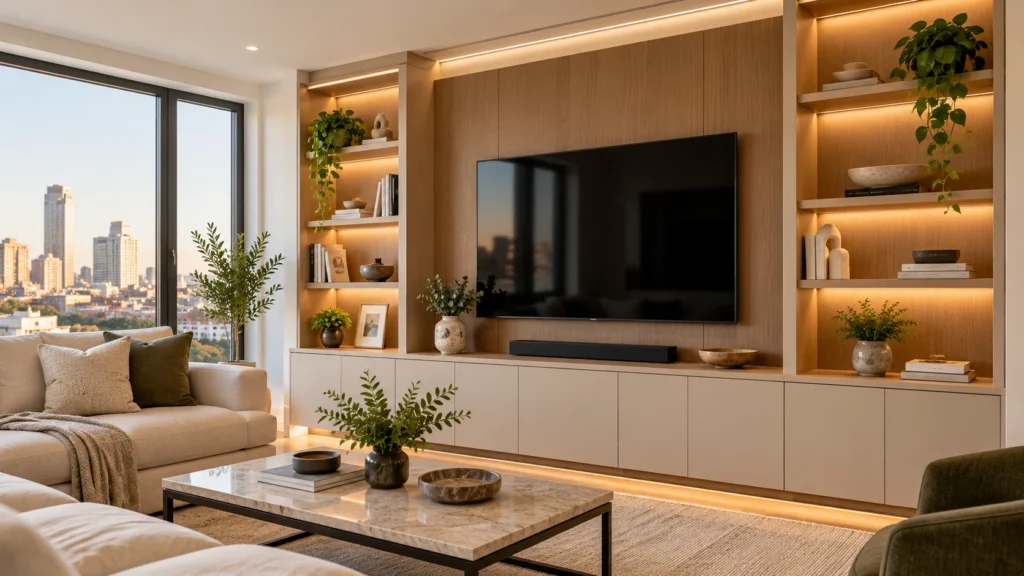
The television is the most dominant object in most living rooms.
It’s usually the first thing people look at when they walk in. It determines where the sofa goes, how the room is arranged, and whether the entire space feels designed or simply furnished around a screen on a stand.
In a New York apartment, where the living room is often the only generous room in the home, getting this decision right matters more than anywhere else. A freestanding media console that almost fits, a cable channel stuck to the wall, and a TV mounted slightly too high these are the details that make a beautiful room feel slightly off every single day.
A built-in TV unit in NYC designed specifically for the room can solve all of it. YD Woodwork approaches these projects as part of a larger custom cabinetry in New York process, where proportions, storage, materials, and installation are considered together.
Here’s how to choose the right one.
Why a Built-In TV Unit Changes the Entire Room
Before getting into specifications, it’s worth understanding how a built-in differs from a freestanding console.
A freestanding TV unit is furniture. It sits in front of the wall. It has a fixed width that may or may not match the wall. It has visible sides. It creates a gap above it between the top of the unit and the ceiling. And the television either floats above it on a wall bracket, visually disconnected, or sits on top, adding even more height to an already visually busy arrangement.
A custom entertainment center in New York that’s been built into the wall becomes architecture rather than furniture.
The difference is immediately visible:
- No visible sides: The unit fills the wall completely, with no gap on either side.
- No gap above: Floor-to-ceiling builds eliminate the dead zone between the top of the unit and the ceiling.
- Integrated TV position: The screen sits within the composition rather than on top of or beside it.
- Hidden everything: Cables, equipment, and storage disappear behind cabinet doors that match the surrounding millwork.
- Visual weight balanced: Open shelving on either side of the TV panel creates a composition rather than a focal point.
A media wall designed this way makes the living room feel larger, calmer, and more intentional. Every decision in a New York living room matters, and this one changes the room more than almost any other single investment.
The 5 Decisions That Determine the Right Built-In TV Unit for Your NYC Apartment
Decision 1: Full-Wall or Partial-Width?
The first decision is how much of the wall to use.
Full wall-to-wall: The built-in runs the complete width of the wall, from corner to corner or architectural feature to architectural feature. This is almost always the stronger visual choice. A partial-width unit on a long wall creates gaps on either side that make the piece look undersized and the wall look unresolved.
Partial width around a feature: When a window, doorway, or radiator interrupts the wall, a custom-built-in media cabinet in New York can be designed around it, incorporating the architectural feature rather than stopping at it.
A built-in that wraps around a window with shelving on either side and a TV niche in the center is a significantly more sophisticated result than a unit placed where the window forces it to fit.
Decision 2: Floor-to-Ceiling or Partial Height?
A full-height built-in uses vertical space that a standard entertainment unit simply cannot.
In NYC pre-war apartments with 9- to 10-foot ceilings, floor-to-ceiling is often worth pursuing:
- The ceiling height is the room’s best architectural asset; a TV unit that reaches it uses that asset rather than leaving it empty.
- Floor-to-ceiling builds incorporate upper storage that no freestanding unit provides.
- The vertical line draws the eye upward, adding perceived height to the room.
The same principle applies to other built-ins. If you’re considering extending the storage beyond the TV wall, YD Woodwork also creates custom library bookcases designed around the dimensions and architecture of the room.
Decision 3: What Goes on Either Side of the TV?
The TV niche itself is a relatively small part of a well-designed media wall. The panels on either side define the composition.
The most popular configurations for TV units in NYC apartments include:
- Open shelving flanking the TV: Books, plants, and display objects balanced on either side, creating a full wall composition.
- Closed cabinets below, open shelving above: The most practical combination for living rooms where equipment, gaming consoles, and general storage need to disappear.
- Integrated fireplace below or beside the TV: Increasingly requested in Brooklyn brownstones and Manhattan apartments with non-functioning original fireplaces.
- Asymmetric layouts: A deeper niche on one side and open shelving on the other, creating visual interest that a symmetric layout doesn’t provide.
If you’re considering a larger shelving system around the TV, our guide to custom bookcases in NYC apartments offers additional ideas for layouts, storage, and integrated media sections.
Decision 4: How Deep Does the Unit Need to Be?
Depth is the most technical decision in a built-in TV unit NYC project and the one most often underestimated.
| Configuration | Build-Out Depth | What It Accommodates |
| Slim wall panel only | 4–6 inches | TV mount, hidden wiring only |
| Shallow shelving unit | 10–14 inches | Books, decor, no AV equipment |
| Standard built-in with cabinetry | 14–18 inches | AV receiver, streaming devices, gaming consoles |
| Full entertainment system | 18–24 inches | Full AV stack, ventilation, full-depth drawers |
In a compact NYC living room, every inch of depth counts. A custom TV wall unit in Brooklyn that extends 20 inches into the room can meaningfully reduce clearance in front of the sofa.
Understanding depth requirements before finalizing the design is essential.
Decision 5: What Material and Finish?
Material defines the room’s personality as much as the configuration does.
Common finishes for built-in media cabinets in New York include:
- Painted matte in warm neutrals: Mushroom, greige, and soft white are versatile choices that work across modern, transitional, and contemporary living rooms.
- Natural white oak: Warm grain and architectural character work particularly well in Brooklyn brownstones and pre-war Manhattan apartments.
- Walnut: Deep chocolate tones and dramatic grain make it a strong choice for statement living rooms.
- Two-tone: Painted lower cabinets with a natural-wood TV niche or open-shelving section create contrast without overwhelming the room.
Hardware adds the final character layer. Matte black, brushed brass, and aged bronze can each create a very different look depending on the finish and overall room design.
For homeowners comparing cabinetry options, YD Woodwork’s custom cabinetry services cover design, construction, and installation from initial concept through completion.

What a Well-Designed TV Unit Does for the Living Room
Here’s what most guides don’t say directly: the television isn’t the point. The room is the point.
A well-designed built-in TV unit in NYC doesn’t make the TV more prominent. It makes the TV less prominent, integrating it into a wall composition where it’s present when needed and recedes into the design when it isn’t.
The best media walls in New York apartments share several characteristics:
- The TV is at the right height: the center of the screen is at seated eye level, roughly 100 to 110 cm from the floor, rather than mounted too high.
- Cables are invisible: Not managed after installation but designed out at the build stage.
- Storage is thoughtful: Equipment lives in ventilated closed cabinets, not stacked on open shelves beside the TV.
- Proportions are considered: The unit’s width relates to the wall, the TV size relates to the viewing distance, and the shelving height relates to the ceiling.
At YD Woodwork, every entertainment center project starts with those proportions before any finish or material is discussed. A beautifully finished media wall in the wrong proportion for the room never looks quite right.
If you’re still deciding between a built-in and a freestanding setup, read our guide to built-in vs. freestanding entertainment centers for a closer look at the differences in storage, flexibility, and long-term practicality.
The NYC Living Room TV Unit: What to Expect at Each Investment Level
| Investment Level | What It Includes | Typical NYC Cost |
| Entry-level built-in | TV niche, simple closed lower cabinets, painted finish | 8,000–15,000 |
| Mid-range media wall | Full wall-to-wall, open shelving + closed cabinets, integrated lighting | 15,000–30,000 |
| Premium built-in system | Floor-to-ceiling, custom millwork, specialty finish, fireplace integration | 30,000–55,000+ |
| Full entertainment wall with library | TV + full library bookcases, rolling ladder, integrated LED, specialty wood | 55,000–80,000+ |
These are investments, not expenses. A well-built custom entertainment center in NYC creates a more cohesive living space and can add to the perceived value of the apartment.
The final cost will depend on the size, materials, finish, storage requirements, and complexity of the installation.
Common Mistakes to Avoid
Before finalizing any built-in TV unit in an NYC project, watch for these consistently made errors:
Mounting the TV too high: Eye level when seated, not standing.
Ignoring cable management until after the build: Retrofit cable management is always more visible than an integrated solution planned from the beginning.
Undersizing the depth: A media wall that can’t fit the AV equipment behind closed doors defeats its own purpose.
Choosing a finish before understanding light conditions: Walnut in a north-facing Brooklyn apartment looks very different from walnut in a south-facing one.
Asymmetric shelving that wasn’t designed to be asymmetric: Intentional asymmetry is striking; accidental asymmetry reads as an error.
A custom TV wall unit in New York can account for cable routing, equipment ventilation, and storage before fabrication begins, which is why planning these details early matters.
YD Woodwork has been designing and building custom entertainment centers across NYC for over 30 years, from floating media panels in Manhattan studios to full-room library-entertainment walls in Brooklyn brownstones.
View YD Woodwork’s custom entertainment center projects to see how different media walls can be designed around the room, then contact the team to start planning yours.
FAQs
How much does a custom TV cabinet cost?
A custom TV cabinet in NYC can cost approximately $8,000 to $80,000+, depending on size, materials, finishes, storage, lighting, and installation complexity. A simple built-in may cost $8,000–$15,000, while larger wall-to-wall entertainment centers with premium finishes and integrated features can cost significantly more.
What is the standard depth of a TV unit?
TV unit depth depends on its purpose. A slim wall panel may require only 4–6 inches, while shallow shelving typically needs 10–14 inches. Standard built-in cabinetry is usually around 14–18 inches, while units designed for larger AV equipment may require 18–24 inches.
Should a built-in TV unit go floor to ceiling in a NYC apartment?
A floor-to-ceiling TV unit can be an excellent choice for NYC apartments, especially those with taller ceilings. It maximizes vertical storage, eliminates unused wall space, and creates a stronger architectural look. However, windows, radiators, doorways, ceiling height, and room proportions should be considered before choosing a full-height design.
What are some ideas for hiding TV cables?
The cleanest approach is to plan cable management during the built-in design stage. Options include hidden cable channels, recessed outlets, in-wall conduit, concealed wiring pathways, and ventilated cabinets for AV equipment. Planning these details before installation keeps cables out of sight and makes future equipment upgrades easier.
What is the ideal height to mount a TV in a living room?
The ideal TV height is generally based on seated eye level. For many living rooms, the center of the screen sits approximately 40–42 inches from the floor, but sofa height, TV size, and viewing position can change the measurement. A custom TV unit should be designed around these factors rather than a fixed height.
Do custom built-ins add value?
Custom built-ins can add value by improving storage, organization, functionality, and the overall appearance of a living room. They can also make better use of unusual NYC apartment layouts and limited wall space. However, resale value varies by property and design quality, so a built-in should primarily solve practical needs while complementing the home’s architecture.


