
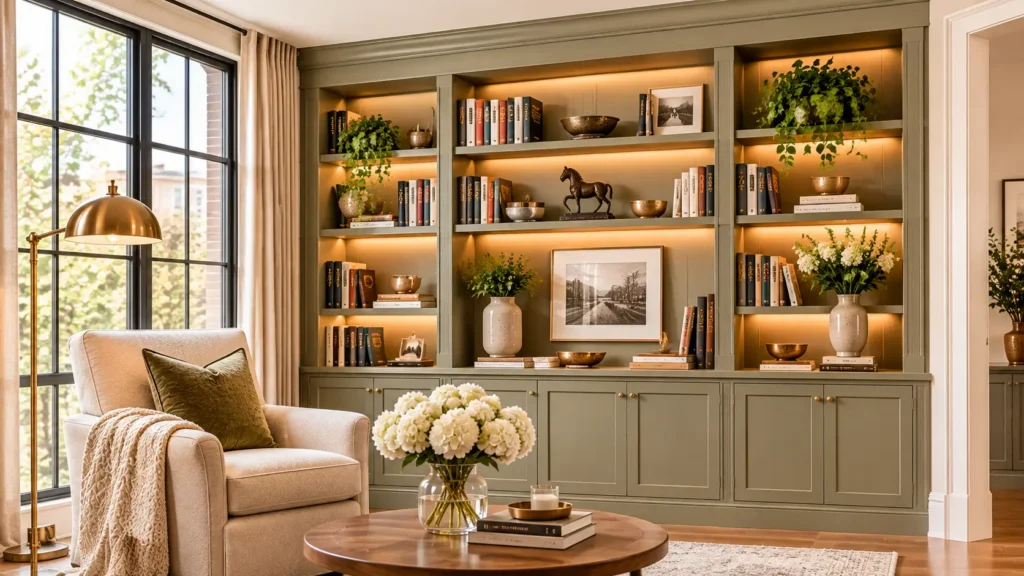
Two neighbors in the same pre-war building, each installing a floor-to-ceiling bookcase in the same month.
One picks cherry because the sample glowed a soft pinkish-gold against her cream walls. The other picks walnut, because it looked dramatic in a photo.
Three years later, the cherry has deepened into a rich reddish-brown that no longer matches her floors. The walnut still looks stunning, but the lower shelves have picked up scratches that show more than they would on oak.
Neither neighbor chose badly. Both chose with half the information.
The best wood for bookcase NYC homeowners can pick isn’t one species. It’s the one that fits your light, your books, and the way you want the room to age. Here’s how to work out which one that is.
Four Questions That Narrow It Down Fast
Before you look at a single sample, answer these:
- How much natural light does the room get? Deep, dark woods can feel heavy in a dim room, while lighter ones keep it open.
- How heavy is the collection? Hardcovers and art books stress shelves far more than paperbacks and décor.
- How should it age? Some woods hold their tone for decades. Others change on purpose.
- Painted or natural? If the bookcase will be painted, grain barely matters. If it stays natural, grain is the whole story.
Your answers do most of the work. The comparison below does the rest.
Maple: The Practical Choice
Hard maple is the workhorse. At roughly 1,450 on the Janka hardness scale, it’s harder than oak, walnut, and cherry, so it shrugs off the dents and scuffs that busy shelves collect. The grain is fine and uniform, and the color runs from creamy white to light amber, which gives it a clean, contemporary look.
That evenness is also why maple takes paint so well. If you’ve read our guide to the best wood for kitchen cabinets, you’ll recognize the logic: the same smooth surface that suits a painted kitchen suits a painted library wall.
Choose maple for painted built-ins, clean modern rooms, and shelving that gets used hard, like a reading nook with a rolling ladder.
Oak: Warm Grain and Serious Stiffness
Oak sits between about 1,290 (red) and 1,360 (white) on the Janka scale. For a bookcase, stiffness matters even more than hardness, and oak resists sagging over longer spans better than softer woods, which is exactly what a heavy collection demands.
Visually, oak is the warm one. Its open grain stays visible under stain, which gives a wall of shelves real texture. It feels at home in rooms that already carry visual weight, like original hardwood floors, plaster walls, and pre-war millwork.
Choose oak for big hardcover collections and for rooms where you want the wood itself to be seen.
Cherry: The Wood That Changes Its Mind
Cherry is the softest of the four at about 950 Janka, so it shows wear first on heavily used shelves. But that’s not why people choose it.
It starts as a warm, pinkish tone and darkens over the years into a deep reddish-brown. In a library meant for slow evenings, that deepening is the appeal. In a room where the color needs to stay put, it’s a problem. Which one it is depends entirely on your room.
Choose cherry for traditional, lived-in rooms where aging is part of the charm.
Walnut: Drama With a Price Tag
Walnut (about 1,010 Janka) is the deep chocolate-brown option, with grain that shifts and swirls across every board. It’s the species most people picture when they think of luxury wood cabinets, and it’s the most expensive of the four. It also shows scratches more readily than oak.
It earns its premium in a smaller, featured space like a reading nook or a media-and-library wall with generous natural light. In a dim room, walnut can feel heavy.
Choose walnut for statement spaces where the wood is the design.
Can’t decide between two species? Contact YD Woodwork, and we’ll hold real samples against your wall, in your light, before you commit.
The Four Woods Side by Side
| Hard Maple | Oak | Cherry | Walnut | |
| Janka hardness | ~1,450 | ~1,290–1,360 | ~950 | ~1,010 |
| Look | Creamy white to light amber, fine grain | Warm tone, open visible grain | Pinkish gold that deepens to reddish-brown | Deep chocolate brown, dramatic grain |
| Best for | Painted built-ins, modern rooms, heavy daily use | Large book collections, warm or traditional rooms | Traditional, lived-in libraries | Statement nooks with good natural light |
| Watch for | Less visible grain if you want wood character | Strong grain won’t suit every minimalist room | Softest of the four; color changes over time | Highest cost; shows scratches more than oak |
| Relative cost | Mid | Mid | Mid to high | Highest |

Solid Hardwood vs. Wood Veneer: What a Brooklyn Brownstone Really Needs
Many people assume a hardwood bookcase in New York means solid planks everywhere. In practice, well-built built-ins usually combine both materials.
Large panels like shelves, sides, and backs are often veneer-faced plywood. It stays dimensionally stable through steam-heated winters and humid summers, when wide solid boards can cup or crack. The exposed edges are then finished in solid hardwood of the same species, so a well-made wood veneer bookcase in Brooklyn reads as solid wood from every angle.
A sensible split looks like this:
- Solid hardwood: face frames, edge lipping, ladder rails, trim, and molding
- Veneer plywood: wide shelves, side panels, back panels, and large cabinet boxes
So the best wood for bookcase NYC projects is often two materials working together, not one. When you compare custom bookcase materials in NYC, ask what is solid, what is veneer, and why. At YD Woodwork, units are handcrafted in our New York workshop from solid hardwoods or veneers, and the right mix is a design decision, not a downgrade.
The Mistake That Matters More Than the Species
Here’s the surprise: most sagging shelves aren’t caused by the wrong wood. They’re caused by the wrong span.
As a working rule, a ¾-inch shelf is comfortable under books at around 36 inches. Stretch it to 48 inches and it will bow, whether it’s oak, maple, or cherry.
The fixes are design decisions, not species upgrades:
- Shorter spans: add vertical dividers every 30 to 36 inches
- Stiffer shelves: use thicker stock or a solid wood front edge
This is why a floor-to-ceiling bookcase that runs wall to wall depends more on its internal layout than on its wood label.
Matching the Wood to Your Space
Use these as starting points, not rules:
- Manhattan co-op, wall-to-wall, big collection: oak or maple. Built-in bookshelves in Manhattan apartments have to earn every inch, and stiff, hard-wearing species hold up to heavy loads.
- Upper West Side apartment with original details: oak or cherry, for warmth that sits comfortably beside original floors and millwork.
- Brooklyn brownstone library or reading nook: walnut or cherry, for depth and character.
- Painted built-ins in any borough: maple, for the smoothest finish.
- Small or dim room: maple or white oak, to keep it light.
If you’re still deciding how much of a wall your shelving should take, see how custom bookcases transform NYC apartments once the proportions are right.
Choose the Wood You’ll Still Like in Year Ten
Trends move. Shelves stay. The best choice is rarely the most expensive or the most photographed species. It’s the one that suits your light, carries your books without bowing, and ages the way you want it to.
At YD Woodwork, that conversation always happens with real samples in the real room, because light changes how every species looks.
Ready to build yours? YD Woodwork designs and installs custom library bookcases across Brooklyn and Manhattan. Book a free design consultation today.
FAQs
Q1: What is the best wood for a bookcase?
Oak and hard maple are the best all-round choices because both are hard and stiff enough to carry heavy book loads. Maple suits are painted, or modern bookcases and oak suits have warm, natural-grain looks. Walnut is the premium pick for statement spaces, and cherry suits traditional rooms that benefit from its darkening tone.
Q2: Is oak or maple better for a built-in bookcase?
Maple is harder (about 1,450 Janka versus roughly 1,290 to 1,360 for oak) and takes paint more smoothly, so it’s better for painted built-ins. Oak has a visible open grain and a warmer look, so it’s better for natural or stained finishes. Both can span long shelves when the design is right.
Q3: Is veneer plywood good for a built-in bookcase?
Yes. Quality veneer-faced plywood is widely used for shelves, sides, and backs because it stays stable through humidity changes. The edges are finished in solid hardwood of the same species, so the piece reads as solid wood. The quality of the core and the edge detailing matter more than the word “veneer.”
Q4: How far can a bookshelf span before it sags?
As a working rule, a ¾-inch hardwood shelf holds up well under books at around 36 inches. At 48 inches it is likely to bow regardless of species. Vertical dividers every 30 to 36 inches, thicker stock, or a solid wood front edge all reduce sag.
Q5: Does the type of wood change the cost of a custom bookcase?
Yes. Walnut is generally the most expensive of the four, cherry sits in the mid-to-high range, and maple and oak sit in the middle. Size, finish, and extras like integrated lighting or a ladder rail also drive cost, so a free consultation is the only way to get an accurate project-specific number.
Q6: How long does it take to build and install a custom bookcase in NYC?
Most custom library bookcase projects take about four to eight weeks from design approval to installation, depending on scope. Co-op and condo board approvals can add time before installation can start.


