
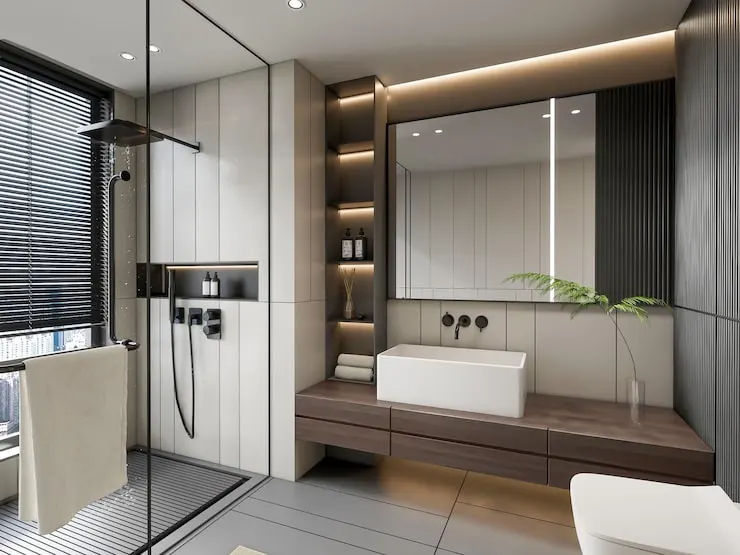
You spend two weekends browsing vanities online. You find one that looks perfect: the right style, the right finish, the right price. You measure your bathroom wall, confirm it fits, and place the order.
Six weeks later, the vanity arrives. You unwrap it, carry it into the bathroom, and push it into position. And then you notice it. A two-inch gap on the left side where the wall isn’t perfectly straight. A drain that doesn’t quite line up with the cutout. A cabinet that looks great in isolation but wrong against your bathroom’s original hex tile floor.
This is not a story about one unlucky homeowner. This is what happens to dozens of New York homeowners every single week.
The real problem isn’t the vanity. The real problem is the decision that came before it: choosing a prefab piece for a space that was never built to standard measurements.
Here’s how to make sure that isn’t you.
The NYC Bathroom Problem Nobody Warns You About
New York bathrooms have a personality problem.
Every pre-war building, every Brooklyn brownstone, and every Manhattan co-op has a bathroom that was built by someone who wasn’t thinking about modern furniture catalogs. Walls tilt. Floors slope. Plumbing runs wherever the original plumber decided it should go in 1923.
Stock vanities don’t account for any of that. They’re built for an average American bathroom, and the average American bathroom does not exist in New York City.
The result is always the same: filler panels, visible gaps, doors that don’t hang straight, and a vanity that looks installed rather than designed. And nobody wants to spend money on a bathroom renovation only to feel like they made a compromise the moment it’s done.
What Prefab Actually Is And When It Makes Sense
Let’s be fair to prefab vanities. They’re not bad products. They’re the wrong product for the wrong space.
A prefab (or stock) vanity is mass-produced in fixed widths, usually 24, 30, 36, or 48 inches, and shipped ready to install. They’re fast, affordable, and widely available. For a standard bathroom in a newer building where the dimensions line up, they do exactly what they’re supposed to do.
Prefab works when:
- Your bathroom dimensions match a standard vanity width exactly
- Your plumbing is positioned right where the vanity expects it
- You need a quick, budget-friendly refresh for a rental or resale property
- The bathroom is in a newer building with standardized construction
The price range makes them appealing; a basic stock unit runs $300 to $800 installed. Even a semi-custom option with a stone top typically ranges from $1,500 to $4,500.
But here’s the truth most people only discover after installation: in New York, where almost nothing is standard, the hidden costs of making a prefab unit work often close that gap considerably. Filler panels. Custom trim: extra labor to level a cabinet on an uneven floor. Suddenly the “affordable” option doesn’t look quite so affordable anymore.
What a Custom Bathroom Vanity Actually Changes
A custom bathroom vanity starts with one principle: your space first, the vanity second.
Before a single cabinet is built, every inch of your bathroom is measured. The wall width, including the bow in the middle. The floor slopes from left to right. The exact position of the drain. The ceiling height. The tile pattern is worth preserving. All of it feeds into a design that’s built specifically for this bathroom, not adapted to fit it.
What that delivers in practice:
- Exact-fit dimensions: the vanity fills your wall, with no gaps, no fillers, and no visual compromises.
- Material choice: solid walnut, white oak, painted hardwood, or any finish that doesn’t exist in a catalog.
- Storage built for you: drawer depths, interior dividers, and pull-out systems designed around how you actually use the space every morning.
- Integrated features: recessed lighting, built-in outlets, double sinks, or a makeup station that wouldn’t be possible with a stock piece.
- Longevity: custom vanities built from real hardwood last 25 to 30 years; most stock vanities show real wear within 5 to 10 years.
The difference isn’t just visual. It’s the difference between a bathroom that feels finished and one that feels furnished. A custom bathroom vanity that fills the exact wall, from corner to corner, floor to ceiling, looks like it was always part of the room. Because it was designed to be.
Ready to see what custom looks like in your space? Contact YD Woodwork for a free consultation today.
Custom Bathroom Vanity Cost in New York: Real Numbers for 2026
Most comparison articles get vague here. We won’t.
Custom bathroom vanity costs in New York run approximately $75 to $250 per square foot from a reputable cabinet maker. In practical terms for NYC bathrooms in 2026, here’s what that looks like:
- Entry-level custom (painted finish, standard layout): $2,500-$5,000
- Mid-range custom (solid hardwood, stone countertop): $5,000-$10,000
- High-end custom (premium wood, double sink, integrated features): $10,000-$20,000+
- Installation labor: $800-$2,000+ depending on complexity
Yes, that’s more upfront. But here’s the number most people don’t think to run.
A $6,000 custom vanity that lasts 30 years costs $200 per year. A $1,500 prefab that needs replacing in 8 years costs $187 per year plus the cost of a second installation, the disruption, and the second round of contractor fees. Add in the workaround labor required to make the prefab fit a non-standard New York bathroom, and the math shifts even further.
Divide the cost by the years of use. The decision looks different every time.

Built-In Bathroom Vanity Brooklyn: A Special Case
Brooklyn deserves its own section. Because Brooklyn bathrooms are not just non-standard; they’re architecturally extraordinary.
Original hex tile floors. Cast iron soaking tubs. Walls that haven’t been touched since before the Second World War. Plumbing that was retrofitted into a layout never meant to have modern fixtures. These aren’t problems. They’re the character that makes a Brooklyn brownstone bathroom worth renovating properly.
A prefab vanity with chrome handles and a laminate top placed against original hex tile is a mismatch that anyone who walks into the room will feel, even if they can’t articulate why.
A built-in bathroom vanity in Brooklyn built from warm walnut, fitted exactly to the wall’s actual width, and finished with brushed brass hardware becomes part of the room’s story rather than an interruption of it.
The practical challenges beyond aesthetics:
- Plumbing locations that don’t match standard vanity drain placements
- Wall depths that vary between rooms in the same apartment
- Floor slopes that require precise leveling to look right
- Tile patterns worth working around rather than cutting through
Each of these is something custom design solves before installation day. Each of them is something prefab discovers on installation day.
The Honest Comparison: Custom vs Prefab Side by Side
| Feature | Prefab Vanity | Custom Bathroom Vanity |
| Upfront Cost | $300 – $2,600 (cabinet only) | $2,500 – $20,000+ (installed) |
| Timeline | Ships in days | 4 – 8 weeks for production |
| Fit | Fixed standard sizes | Built to your exact dimensions |
| Materials | MDF, particleboard, laminate | Solid hardwood, plywood, real stone |
| Lifespan | 5 – 10 years | 25 – 30 years |
| Storage | Generic layout | Designed around your habits |
| Workarounds needed | Often especially in NYC | None designed for your space |
| Resale value | Minimal impact | Adds measurable value |
| Best for | Standard spaces, short-term | NYC apartments, long-term homes |
When Prefab Is the Right Call And When It Isn’t
To be straight with you: prefab isn’t always the wrong answer. Here’s the honest version.
Choose prefab when:
- Your bathroom is in a newer building with standard dimensions
- You’re refreshing a rental property or preparing for a quick resale
- You’re on a tight timeline and need it done fast
- The space is genuinely standard, and the fit will be clean
Choose a custom bathroom vanity when:
- Your bathroom has non-standard dimensions, angles, or plumbing placement
- You want materials that survive more than one renovation cycle
- You’re matching cabinetry elsewhere in the home
- You want integrated features: lighting, double sinks, built-in storage
- The bathroom is in a pre-war building, brownstone, or any older NYC property
For most New York apartments where the bathroom is pre-war, the walls aren’t square, and the renovation is meant to last, custom wins on every metric that matters in the long run.
The Decision That Makes a NYC Bathroom Worth the Investment
Here’s the thing nobody says out loud when you’re standing in a showroom.
The vanity you choose is the single most used piece of furniture in your bathroom. You interact with it twice a day, every day, for as long as you own the home. The two inches it doesn’t quite fill. The drawer that doesn’t quite close. The gap at the top where it stops short of the ceiling. These are things you will notice every single morning for years.
A custom bathroom vanity removes every one of those moments. It fits because it was built to fit. It lasts because it was built from real materials. It looks right because it was designed for this specific room, not adapted from someone else’s standard.
Prefab vanities are built for standard homes. New York homes are rarely standard. And the gap between those two facts is where most bathroom renovations either succeed or quietly disappoint.
FAQ’s
Q1: What is the difference between custom and prefab vanities?
Prefab vanities are mass-produced in fixed standard sizes and available off the shelf. Custom vanities are built to your exact wall dimensions, plumbing layout, and storage needs, giving you a precise fit, better materials, and a significantly longer lifespan.
Q2: How much should a custom bathroom vanity cost??
In New York, a custom bathroom vanity typically starts around $2,500 for a basic build and can reach $20,000 or more for a high-end double-sink unit with premium materials. The price depends on size, wood species, countertop material, and installation complexity.
Q3: Are custom bathroom vanities worth it?
For most NYC homeowners, especially in pre-war apartments and brownstones, yes. A custom vanity fits your exact space, lasts 25 to 30 years, and eliminates the workarounds that stock vanities always require in non-standard New York bathrooms.
Q4: How long does it take to get a custom bathroom vanity built and installed in NYC?
Most custom vanity projects take four to eight weeks from design approval to completed installation. Simpler builds come in faster. Complex designs with specialty wood, stone countertops, or integrated features sit at the longer end of that range.
Q5: What is the best material to build a bathroom vanity from?
Solid hardwood, white oak, walnut, or maple is the most durable choice for a bathroom vanity. It handles moisture well when properly sealed and lasts far longer than MDF or particleboard. For countertops, quartz is the most practical option, with marble and quartzite as premium alternatives.
Your bathroom deserves better than almost fitting. Contact YD Woodwork today for a free consultation—no obligation, honest advice for your specific space.


