
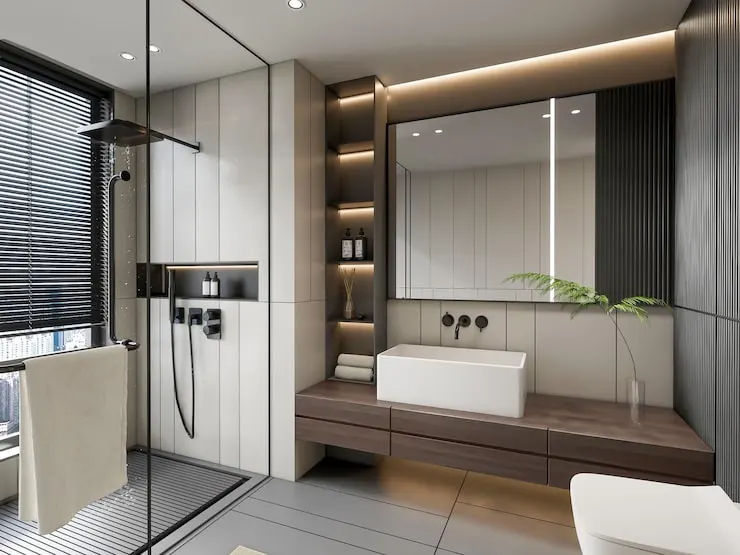
Most homeowners spend months obsessing over kitchen cabinets and almost no time thinking about the bathroom vanity.
That’s a mistake. Your vanity is the first thing you see every morning. It sets the tone for the entire room, determines how functional your routine feels, and quietly signals the quality of everything around it.
The right bathroom vanity design doesn’t just improve how your bathroom looks. It changes how the room works, how it feels, and how much you enjoy being in it. This guide covers everything you need, from modern styles to luxury finishes to fully custom builds, so you can make the right choice for your space.
Why Bathroom Vanity Design Matters More Than You Think
A vanity isn’t just a sink with storage underneath.
It’s the focal point of the bathroom. The piece that every guest notices. The one fixture that, when it’s wrong, makes even a well-renovated bathroom feel unfinished.
In practice, a poorly designed vanity creates clutter, eats up space, and makes even a large bathroom feel cramped. A well-designed one does the opposite: it opens the room up, adds warmth, and makes the space feel deliberate.
Design and function should never be separate conversations. The best vanities handle both without compromise. And yet most people pick one or the other, a cabinet that looks great but has no storage, or a practical unit that clashes with everything around it.
The goal is always both.
Modern Bathroom Vanity Designs: Clean Lines, Bold Impact
If your home leans contemporary, modern bathroom vanity designs are hard to beat.
Modern vanities are built on restraint. Less ornamentation, more intention. Every detail serves a purpose, and the result is a space that feels clean, calm, and current.
What Defines a Modern Vanity
- Flat-panel or slab cabinet doors: no decorative framing, no raised profiles
- Floating or wall-mounted installation: lifts off the floor to create visual breathing room
- Matte finishes, in white, grey, navy, or black, are highly popular in NYC homes right now
- Integrated sinks that sit flush with the countertop for a seamless, uninterrupted surface
- Minimal hardware, or none at all, using push-to-open mechanisms instead
The appeal is how much impact restraint delivers. A single floating vanity in deep charcoal with a white quartz countertop can carry an entire bathroom without needing anything else around it.
Luxury Bathroom Vanity Designs: When Quality Is the Point
There’s a clear difference between a bathroom that looks expensive and one that genuinely is.
Luxury bathroom vanity designs aren’t about status. They’re about materials, proportion, and craftsmanship. The kind of quality that you feel every time you open a drawer, not just something you admire from across the room.
What Separates Luxury From Standard
- Solid wood construction, not particleboard, not MDF. Real hardwood that holds its integrity for decades
- Natural stone countertops, marble, quartzite, or honed granite, not engineered alternatives
- Custom sizing that fills the space precisely, no awkward gaps, no filler panels
- Soft-close hinges and drawer glides are a standard feature, not a paid upgrade
- Statement mirrors and integrated lighting were designed as part of the vanity unit, not chosen separately afterward
The Long-Term Cost Argument
Luxury vanities tend to last decades, not years. When you invest in quality materials and precise joinery, you won’t have to replace the vanity again in seven years.
That changes the cost equation significantly. A $4,000 vanity you replace twice costs more over 20 years than an $8,000 vanity built to last. In New York, where renovation access is limited and disruption is expensive, longevity isn’t just a preference. It’s a financial decision.
The Double Vanity
Double vanities are one of the most-requested luxury upgrades in master bathrooms right now. Two sinks, individual storage zones, a shared countertop, and enough separation that two people can get ready at the same time without getting in each other’s way.
In a Brooklyn brownstone master bath or a Manhattan apartment with sufficient square footage, a double vanity is one of the most practical luxury upgrades you can make.

Custom Bathroom Vanity: Built for Your Space, Not Someone Else’s
Stock vanities come in set widths, typically 24, 36, or 48 inches. But most bathrooms, especially in New York, weren’t built around those measurements.
A custom bathroom vanity is designed and built to fit your exact space, plumbing layout, storage needs, and design preferences. Nothing is compromised to meet a standard size.
When Custom Makes the Most Sense
Custom isn’t always necessary, but it’s often the smartest choice when:
- Your bathroom has an awkward corner, a sloped ceiling, or an alcove that stock sizes can’t fill
- You want integrated features like pull-out shelves, built-in organizers, a makeup station, or a hamper drawer
- You’re matching existing cabinetry elsewhere in the home, kitchen, closet, or hallway built-ins
- You want a specific wood species, finish, or hardware that isn’t available off the shelf
What the Custom Process Looks Like
At YD Woodwork, every custom bathroom vanity starts with a conversation about how you actually use the space.
From there, precise measurements, material selection, in-house construction, and professional installation are all handled under one roof. Nothing gets lost between a showroom and your bathroom. Nothing is outsourced to a manufacturer who’s never seen your space.
The result is a vanity that fits perfectly because it was built for exactly this room and nothing else.
Vanity Design for Small Bathrooms: Making Every Inch Work
Small bathrooms require smarter decisions, not smaller ambitions.
The right vanity design for a small bathroom can make a compact space feel open, airy, and surprisingly functional.
Strategies That Work
- Go floating: A wall-mounted vanity with open floor space underneath immediately makes the room feel larger. The eye travels across the floor without interruption, and the visual effect is significant even in very tight spaces.
- Choose light finishes: White, soft grey, and warm linen tones reflect light instead of absorbing it. In a windowless bathroom or one with limited natural light, the finish choice makes a real difference.
- Prioritize vertical storage: A slim, tall cabinet beside the vanity, a recessed medicine cabinet, or built-in shelving above the toilet adds storage without eating any floor space. Going up instead of out is the core strategy in any tight NYC bathroom.
- Keep the countertop clear: Under-mount sinks and integrated storage drawers eliminate the clutter that makes small bathrooms feel chaotic. When the counter surface is clean, even a small bathroom feels calm.
How to Choose the Right Bathroom Vanity Design for Your Home
With modern, luxury, custom, and size-specific options all on the table, how do you narrow it down?
A few questions that cut through the noise:
- What’s your bathroom’s square footage? Smaller bathrooms benefit from floating vanities, light finishes, and compact profiles. Larger bathrooms can handle deeper, more substantial pieces without feeling crowded.
- What’s your storage situation? If counter clutter is a constant problem, prioritize drawer storage and closed cabinets over open shelving. If you have minimal products, open shelving can add warmth and visual interest.
- What materials are already in the room? Your vanity should work with your existing tile, flooring, and fixtures, not fight them. If you have warm-toned floors, a wood-finish vanity extends that warmth. Cool tile works better with painted or lacquered finishes.
- What’s your long-term plan? If you’re renovating to sell, clean modern designs have the broadest buyer appeal. If this is your forever home, invest in the luxury or custom route. You’ll use it every single day; it should reflect that.
Bathroom Vanity Materials: What Holds Up Best
The finish looks great in the showroom. The question is how it looks in five years.
Here’s a quick breakdown of the most common vanity materials and how they perform over time:
- Solid wood: the most durable option. Takes moisture well when properly sealed and finished. Ages beautifully. Best for high-end and custom builds.
- Painted MDF: smooth, clean finish ideal for modern styles. More susceptible to moisture damage at edges and seams if not well-sealed. Budget-friendly and widely available.
- Plywood construction: stronger than MDF, resists moisture better. Often used for the cabinet box in quality custom builds, even when the exterior is painted.
- Thermofoil/laminate: very affordable, easy to clean, but can peel over time in humid bathrooms. Best for short-term or rental applications.
For a bathroom that you’ll use daily and want to last, solid wood or quality plywood construction is always the right call.
Final Thoughts
The right bathroom vanity design does more than improve one room. It raises the standard of the entire home.
Whether you’re drawn to the clean simplicity of modern design, the craftsmanship of a luxury build, or the perfect fit of a fully custom vanity, the goal is the same. A space that works exactly the way you need it to, built to last well beyond the next trend cycle.
Don’t settle for something that almost fits your space. You deserve a vanity built for it.
Contact YD Woodwork today for a free consultation. With over 30 years of experience crafting custom cabinetry across Brooklyn and New York City, we design and build bathroom vanities that are made exactly for your space and built to stand the test of time.
FAQs
1. What type of vanity is best for a small bathroom?
A floating wall-mounted vanity is the best choice; it creates the illusion of more floor space. Keep the width between 24 and 36 inches and choose light finishes to make the room feel larger.
2. What is the current trend for bathroom vanities?
Warm wood tones like walnut and white oak paired with matte black hardware are the biggest trend in 2026. Floating designs with minimal hardware and integrated sinks are leading the way in NYC homes.
3. Is it cheaper to build your own vanity?
DIY can save on labour, but material and finishing costs add up fast. A custom-built vanity from a professional offers better fit, finish, and long-term value.
4. What are the new bathroom trends for 2026?
Natural materials, warm earthy tones, and wood-finish vanities are replacing the all-white bathroom look. Double vanities and integrated storage are also in high demand across New York homes.


